
Stackmon Wood Guide: Packs, Routes and Lumber House
Fix a Stackmon wood shortage by cycling the starter pack, spending AP on forest routes, completing construction missions, and scaling a Lumber House.
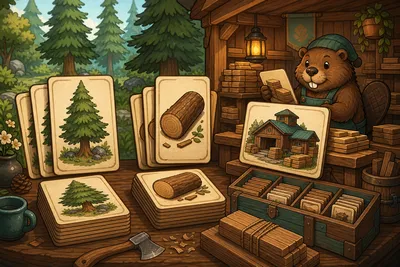
Use three wood routes in order: cycle the first affordable pack and sell surplus cards, spend Adventure Points on forest exploration when packs refuse to cooperate, then build a Lumber House after you gain Iron Ingots. Do not wait for one random pack to solve every bottleneck.
The official game describes packs, gathering, crafting, buildings, and automation. Exact resource routes below are current community reports checked on 30 August 2026.
Patch note (9.0.78): buildings now enter a Depleted State instead of disappearing when their uses run out. Campfire, Garden, Lumber House, Mine and AP Machine are affected, and Depleted buildings can be restored through specific recipes — so a Lumber House you almost drained is recoverable. Later patches also fixed treasure chests not stacking (9.0.84), books and eggs stacking (9.0.85), and made Storage usable from School recipes (9.0.81).
Fast Choice Table
| Your situation | Best next action |
|---|---|
| Very early camp, low money | Buy the first pack, work every sellable card, and recycle surplus value |
| Mission available | Complete it first for AP and progression rewards |
| Several AP available | Explore forest routes and defeat trainers while gathering trees and loot |
| Iron unlocked | Follow the construction quest and prepare a Lumber House |
| Building has one charge left | It becomes Depleted (not destroyed) since patch 9.0.78 — restore it with the Depleted-state recipe instead of rushing an upgrade |
Route 1: Cycle the First Pack
A current Steam reply reports that the first pack costs less than the total sell value it usually returns. The point is not that every opening is profitable; it is that hoarding every low-tier card freezes the economy.
Keep what supports your next mission or build. Sell:
- surplus rocks, berries, or duplicate low-priority resources;
- items you can replace immediately;
- pack output that does not contribute to your current route.
Creator walkthroughs repeatedly show this pack-work-sell loop as the first source of wood, rocks, berries, coal, Stack Gems, and Idea cards.
An Idea card registers its recipe when discovered. Multiple walkthroughs show that you can confirm the recipe in the list and then sell the physical hint card. Right-click an important resource to inspect other recipes that use it before spending a scarce card by experimentation.
Route 2: Spend AP on Forest Exploration
The resource discussion reports trees deeper in the forest and apples from early forest trainers. Creator footage also shows forest packs, tall grass, trees, route challenges, trainer drops, and backpack pressure.
Exploration is better than endless camp packs when you need several things at once:
- wood or trees;
- apples or other healing ingredients;
- ropes, bricks, coal, or route-specific drops;
- new Stackmon;
- progress toward the next route.
Reserve backpack slots before leaving. A route full of useful cards is not useful if low-value items occupy every slot.
Route 3: Build the Lumber House
The current Steam discussion reports this recipe:
2 Trees + 3 Wood + 1 Iron Ingot, with a worker performing the build.
It also reports that the recipe arrives through the construction quest around mountain/iron progression. This is not an official recipe table, so confirm the Idea card in your current version before consuming the materials.
The Lumber House converts wood from a random-pack problem into a planned production step. Build it when:
- your progression already supplies Iron Ingots;
- repeated wood shortages block houses or infrastructure;
- you have a worker you can dedicate without stalling exploration.
Preserve a Nearly Empty Building
Community replies describe an upgrade tactic:
- use the first Lumber House until one charge remains;
- build a second Lumber House;
- also leave one charge on it;
- stack the two and assign a worker to create the upgraded building;
- the upgraded building receives refreshed charges.
This is a current player report, not an official durability rule. Verify the preview before committing two buildings.
Reduce Board Clutter While Processing
One player recommends placing a full stack of raw resources on one worker and the first processed form on a nearby worker. Finished cards can then jump into the matching nearby stack instead of spreading across the board.
Use four zones:
- raw materials;
- processing;
- mission/build reserves;
- sell pile.
Launch walkthroughs also show three useful organization actions: grid-snapping cards, locking a hovered stack, and sweeping matching cards while dragging. Lock mission reserves and limited buildings; use the grid for production lanes; sweep finished resources into their matching pile. Key bindings can change, so follow the current control hint.
When a common mission resource is urgent, assign several compatible workers to the same task. Launch footage shows that shared work completes faster, while element-matched Stackmon can perform some jobs more efficiently. Return the workers to separate chains after the mission or bottleneck clears.
The goal is not a perfect board. It is preventing a rare resource from disappearing under ten unrelated cards. The tips and hidden controls guide covers the full workflow.
AP Is Also a Resource
When a material can be found in a route, you are choosing between pack money, crafting time, and AP. Complete Professor Pine’s missions before a long production session so you do not solve a wood shortage by creating an AP shortage.
Official vs Reported
The official Steam page confirms more than 25 buildings, crafting, automation, gathering, packs, and biome exploration. Forest locations, the Lumber House recipe, charge-upgrade tactic, and suggested routes above are community-reported and may change in an update.
Related Guides
Evidence Note
Checked 21 August 2026. Resource decisions are based on current Steam community replies and cross-checked against multiple creator walkthroughs. Idea-card cleanup, multi-worker tasks, board locking, and grid organization appear in launch footage; exact costs and key bindings remain version-sensitive.
Patch note (9.0.88): Vine Cut can now be used on Lumber Houses, making wood harvesting more flexible. Patch note (9.0.91): the September 9 hotfix fixed an error that could occur when loading the Stackpedia, and fixed Houses becoming unstacked when loading a save.
Patch note (9.0.97): the September 18 patch changed three things players will notice: Fishing now has an affinity with Water Stackmons, the Essence Machine costs 2 Essence instead of 1 when upgrading Essences, and equal recipes from different upgraded buildings now show only once on Recipe Lists. It also fixed cards unstacking on load, Soot Rifts duplicating cards, money not returning from a Soot Rift, and Adventurer tasks failing to start after a load.